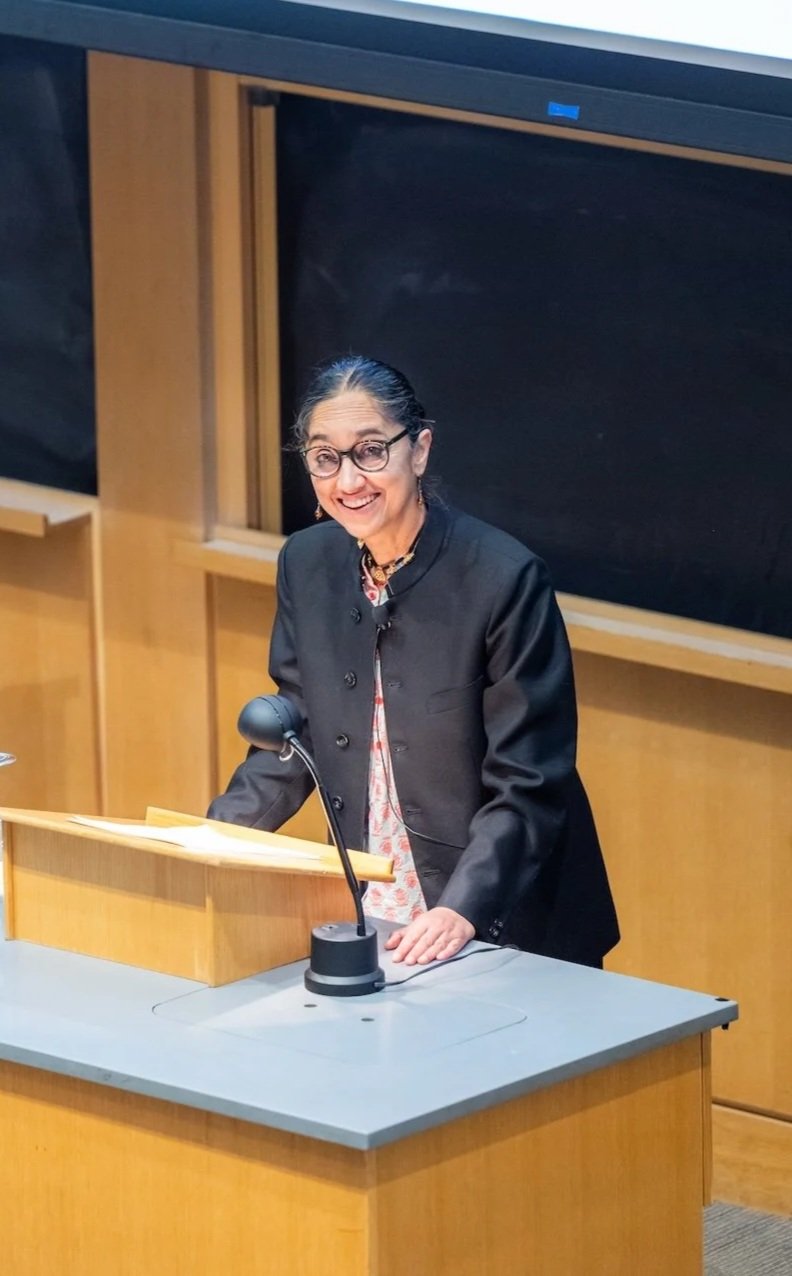
The Pembroke Center at Brown University has been a hub for feminist theory and activism since 1981. Today, under the leadership of Director Leela Gandhi, the Center continues to evolve, expanding its mission to center marginalized voices while maintaining its commitment to rigorous scholarship and archival preservation. I spoke with Gandhi, along with faculty members Denise Davis and Helis Sikk, and Head Archivist Mary Murphy, about the center’s past, present, and future.
Melaine Ferdinand-King: The Pembroke Center has changed significantly since its founding. How do you understand the center’s original vision, and how has your leadership reinterpreted it?
Leela Gandhi: From my perception, the Center had all the rudiments that we’ve built on. It saw itself as a kind of theory hub. And at that particular historical moment, theory was French deconstruction and a certain genealogy of Western philosophy with offshoots that were sort of on the margins.
When I joined, actually two things happened. One was Black Lives Matter and the other was Roe v. Wade. I entered at a moment and an opportunity and I think I wanted to bring that into the Center. So the first thing I wanted to do was to really try and be grounded. And by that I mean to take very seriously what organic intellectual work means, which is not about theory that’s relevant, but a kind of need for abstraction that comes from blood, sweat, and tears. I went to the public and I counted on the fact that the impulse toward abstraction was already there in the Center and the impulse towards rigorous archival work. So these impulses for abstraction and archiving were already there in the intellectual infrastructure, but what it needed was some kind of connection—speaking to the pain, speaking to the moment. And there was a lot of pain because of the pandemic.
I think that now we are doing organic intellectual work everywhere because we speak to the pain, we abstract it, we archive it, we teach it, and we talk about it. I introduced the Pembroke Public Lecture series.
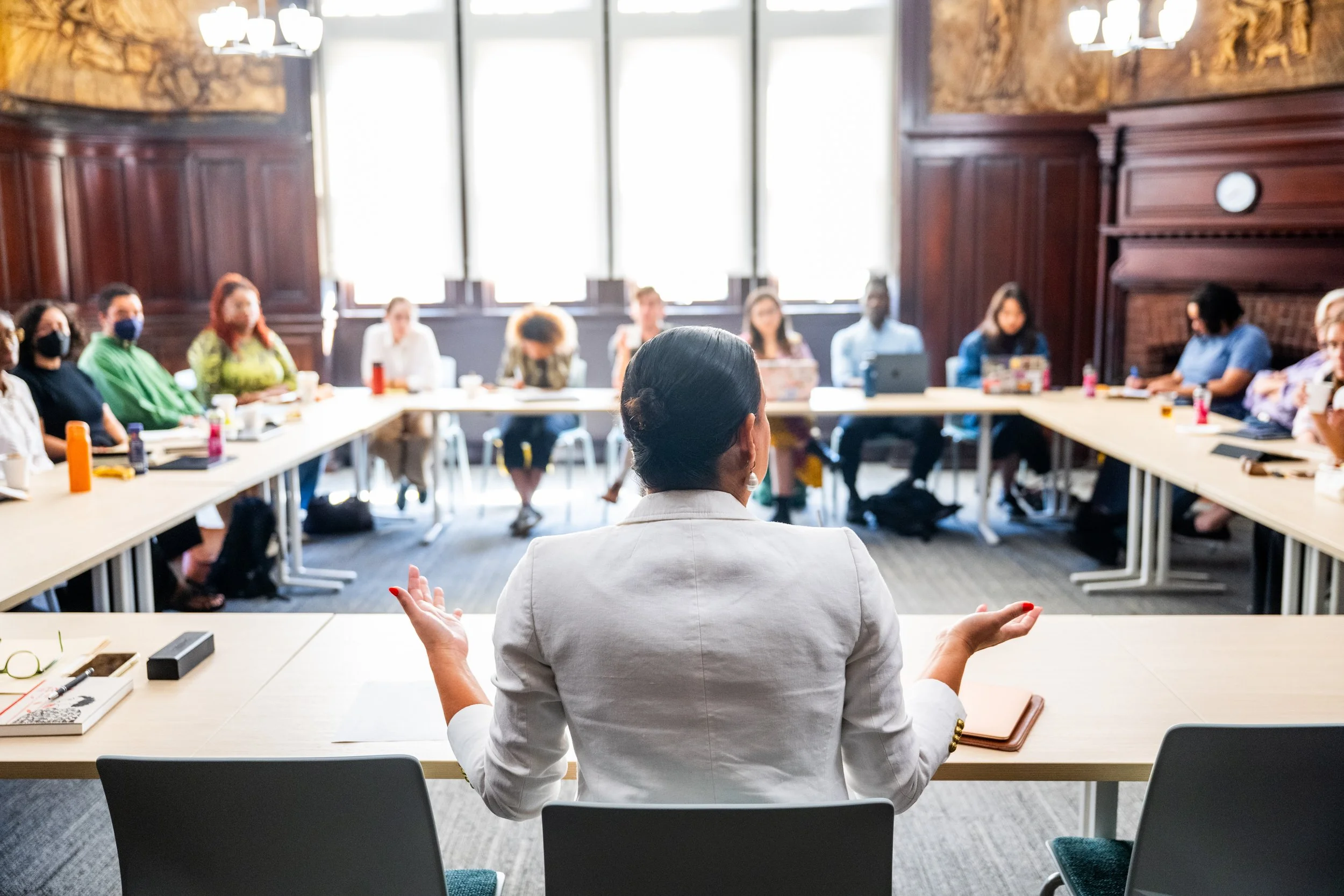
Can you tell us about that series?
Denise Davis: This started in 2022 with Alexis [Pauline Gumbs], and that really exemplifies what Leela was talking about, taking an organic and creative approach to very real issues concerning violence, gender identity, and sexual orientation. And there’s often a transnational approach to that as well. Then we had Dorothy Roberts, then we had Shirin Neshat, an artist. This is a series that invites not just scholars but scholars, artists, and thinkers. We have done a mix of having early career people, people who are younger, and then people who are really advanced like Dorothy Roberts who are really known in their field. So it's been a very successful series and I think it’s just the variety of people that we have included as part of it as well. I think it’s given the series such life in that sense.
You’re running a feminist institution inside an Ivy League university. How do you handle that tension and what does it mean to try to build something transformative when you're working within an institution such as Brown?
Denise Davis: This was a question at the inception of the Pembroke Center. There was a great interview actually with Derrida about the beehive—how do you be a cell in the beehive, but not be of it? How do you counter, how do you do things differently from within the institution? I think it's been a challenge and a tension since we started. I think it’s been enormously important that we have our own endowment and so we have a lot of control over our programming. We have a journal—the editorial board of that journal doesn't answer to anyone. So the content is absolutely designed there and the same with the programming.
Leela Gandhi: Absolutely. I think one of the things we also tried to do is think about community. Wherever you are, if it thrives then it thrives everywhere. So we really kind of try to open our doors a little bit. And here I think of the work that Mary is doing in the archives—because the archives reach locally and have always done that. I think Mary has done that instinctively. So to keep that alive and also to make this a community space. And I think what we've noticed now is how the demographic has changed—people feel safe. I know it's a contested word. I don’t mind being safe. I like being safe. It just gives you the head space to think. So we’ve seen all kinds of demographic shifts. It’s not just academic—it’s trans students, non-binary students who just feel they can come here as they are and bear witness to what’s going on.
Mary Murphy: What I would say is one thing that we do here is we tell the truth. We confront reality. We tell the truth in what we're doing and we do that through data based in the archive. We measure what the truth is within special collections of Brown. We then honestly look at the state of affairs and then work with our colleagues and our community around us to figure out how to bring more truth to special collections, to make things richer and to provide a deeper intellectual experience for those who use our resources.
In our relationship, we work in partnership with special collections at Brown, but we are autonomous from them and that allows us to take those measurements and engage with the reality of special collections here at this institution in a really honest way. In terms of our archive, where it touches the community, there is this interaction between the ivory tower, Brown University, and the community that always has been since founding of the Pembroke Center in 1981. Scholars like Anne Fausto-Sterling was studying the biology of gender going way back, and at the same time Anne was a part of these radical feminist groups here in Providence. There was this very rich interaction between Brown and the Providence community. That's always been at our core, at the root. And so we've always been following those threads and pulling on them through our collecting. That's where you see our work with folks like the Womxn Project and Coyote Rhode Island.
Helis Sikk: That's how we can do feminist work within this institution. One of the key things with archival materials is people bring in their materials and it's not going to get processed for maybe 10 years. The Smithsonian, the Library of Congress—it's like a black hole at times. But here, we have reciprocity. We talk to people—here's how we're going to go about it, here’s how long it's going to take, here's what we're going to be doing with them. It is about relationship and community and reciprocity. I think that's what makes the archive work here feminist. The ethics of care around that matter.

The personal is political has been a feminist rallying cry for decades, but we still see politics that ignore the whole of the body. How is the Center putting bodily autonomy and health access back at the center of feminist work?
Leela Gandhi: We have something we call the Public Health Collaborative. It's small scale, but it's really focused on reproductive justice. The non-binary turn in queer [studies] is a turn toward embodiment. There's no escaping it. What's lovely is what it makes of embodiment as something that's flesh and also ontology. So it makes embodiment something very, very particular and very, very abstract. So the idea of embodiment itself has been transformed to mean “who am I?” “Why am I?” “Does God exist?” “Is there life after death?”—those four great philosophical questions that have become questions bound to embodiment.
But also I think it's the non-binary turn in queer and it is Afro-pessimism, which are these two movements I think of hedonistic renunciation. “I don’t want this, I don’t want the joy. I don't want this body” because I want to be an angel. So it’s a kind of metaphysical, hedonistic renunciation to which the very ideal of the body has become central. So there's no getting away from it now. I mean embodiment is—if someone were to say, this is not something that comes out of post-colonial theory actually. It comes out of these two moments and it's going to become essential. I really think that embodiment is what contemporary theory deals with. Even issues of planetarity—this whole question of what we eat and what we wear and “are we mushrooms?” I’m not a human, I’m not white, I’m not Black, I’m not woman, I’m not—all this language of flesh and lesion and wounding and cutting and healing and repair. It's actually terribly interesting. We live in dark times. So talking to you is making me think that intellectually, we live in really amazing times, amazing times.
Yes, these certainly are surreal times.
The Center does a lot of work interrogating how categories are used to differentiate people. How does Pembroke actually practice intersectionality—not just theorize it, but actually do it?
Leela Gandhi: I don’t think we do intersectionality well anymore. I’m a child of Indian nationalism and 1950s, 1960s, 1970s Black civil rights. That’s the intersectionality I know, and it’s an intersectionality that actually comes out of communism and socialism. People were insistent on solidarity. So there were these lists of solidarities—Bayard Rustin, a Black queer man with Jawaharlal Nehru, as heteronormative as you come, beautiful leader of India, sitting close together, leaning into each other. That kind of solidarity.
Why does that matter? Why are we in this mess now? Because those people who did intersectionality actually thought about those who don’t have enough to wear or have enough to eat—Black, white, whatever—who just need to have more, who need to live, who need to have certain calories in their diet. Those questions, we don’t think about that in the same way. I don't want to just say class, but class was a big placeholder for those solidarities. We certainly cover the bases. We make sure in our programming that we are transnational, gender diverse, sexuality diverse. But I don't believe that—I think we all lost the plot of intersectionality.
Denise Davis: Identity has always been fraught. I think the question of differences encapsulated in intersectionality wasn't any specific axis of difference. It wasn’t racial difference, it wasn't gender difference, it wasn’t [male/female]. I think one of the big contributions of the Center was not being a women's center. We were asking, “What are women?” And that immediately brought all of these differences. And so I think that in that sense we were intersectional from the beginning before intersectionality had a name.
But I think intersectionality doesn’t solve the problem of identity. We found that again and again. When you’re excluded on the basis of a category, having a claim without appealing to that category is difficult. But what I’m seeing among students now, to my delight I must say, is an understanding of their intersectional identities without any kind of foregrounding. I don’t see them making claims on the basis of being “a something”. I’ve never seen a more intersectional movement than Black Lives Matter from the beginning. It was disabled people there. They really dispelled the whole understanding of what African American politics is about, and being women-led was obviously crucial.
Leela Gandhi: An idea that a feminist center is probably very well placed to think of an existential commons. When Du Bois writes to the U.N. claiming human rights violations against the Black population in the U.S., B.R. Ambedkar, who's the leader of the caste revolution in India, writes to Du Bois and says, “Can you send me the model for that appeal because I think I want to claim that for so-called untouchables in India?”
It’s about that strategy— “Can I have a bit of your suffering? Will you take a bit of mine? Can we transact the suffering?” I think that’s something really lovely.
What would you say is the relationship between community, recreation, and public health or social wellbeing?
Leela Gandhi: It’s interesting, I’m thinking, “What is public health really?” It’s a question of malaise—a question of malaise becomes the basis for collectivity. That’s what public health is. But it's a public discourse. It's like, the malaise of my body is a form of collectivity as healing, but [also] a form of collectivity as symptom, as a pharmacon, as the thing that makes you sick as the thing that heals you—that's what it is. You see, I think we started with the feminist slogan, “The personal is political” but there is this way now where the public is personal.
Mary Murphy: And see, this is when the Pembroke Center works. That was so beautifully stated. And then in our collection we have Rhode Island Women’s Health Collective oral history and archival collection. This is a group of women that were being disembodied from the American medical system largely in the 1970s and 1980s and 1990s. And it is through their pain and suffering of having no control over their bodies in their hospital as they were having children, in the doctor’s office. It’s this physical pain, again, from the theory to the material, in our archive, these women speak to this. And because of that pain that was inflicted upon them, they organized and they become. The Rhode Island Women’s Health Collective is a solidarity movement amongst women who have been harmed by a patriarchal medical structure within the United States. And so we have this theory. We are thinking this through our director, through our faculty, and then we have the brass tacks. Where the archives back up what Leela was saying.
What would it mean both practically and symbolically if centers like Pembroke disappeared?
Denise Davis: My most optimistic self says that organically, we will always have these conversations as they were always had before—in salons, in beauty shops, and kitchen tables. But that said, you can’t replace the kind of structure and resources that we enjoy right now.
Leela Gandhi: When spaces that nourish even a few people disappear, it’s like a bereavement. When you bereave a loved one you feel, “Oh, my place of play has gone.” I think that’s what would happen if centers like this disappear. There would be political bereavement. We mustn’t let that happen. What I emphasize with places like this is that they are places of recreation. I think we talk too much about missions and models and templates and programs, but it’s just good to have a semi-formal place where people can come here and recreate. I have no ambition, no grand narrative. I just want this to remain a place of recreation.
Mary Murphy: We know our stories will be swamped and it will change the history books. We have fought so hard with our colleagues to close the gap, to provide resources where women’s voices are included. If we stop doing that work, the collections won’t come in, and you won't be able to study these subjects. That means no Hortense Spillers, that means no Heather Love, that means no Mumia Abu-Jamal. With us goes the history.
Who are the voices doing work right now that everyone should know about?
Leela Gandhi: I’m hesitant. I think we just need to look outside the box. Really what we need to know is what we don't know. Who are the women in refugee camps? Who are the queer people appointing house mothers in Kenya? Who are the men and women standing up to the most pernicious sexual violence in South Asia? Those are the people we just need to find.
I think this is precisely a time for non-canonicity from different parts of the world. Not just to gather canonical elite voices from around the world, but to look in heterodox spaces and through mediums.
That’s the work we have to do.